
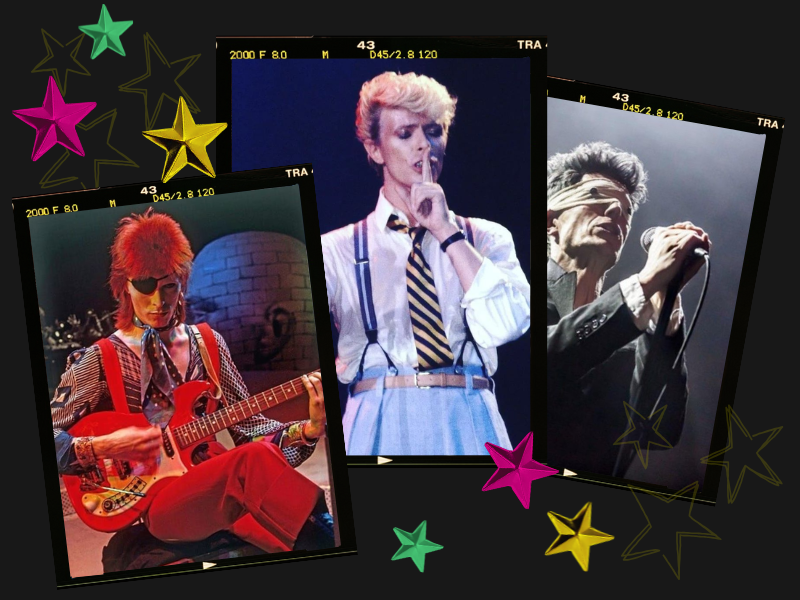
We thought he came from space with his offbeat looks and flamboyant hair—an intriguing actor, musician, lyricist, and extravagant singer: David Bowie, a rebellious artist from another galaxy.
From Space Oddity in 1969 to Blackstar in 2016, David Bowie is an icon of the strange and unusual. Known for his eccentric alter egos like Ziggy Stardust or Halloween Jack, Bowie left his mark on the worlds of fashion and music with alien looks and concepts. More than just a musician, he was also an actor, appearing in over thirty films including Labyrinth (1986) and Merry Christmas, Mr. Lawrence (1983). Creator of hits like Let’s Dance and Modern Love, David Bowie continues to influence pop culture eight years after his death.
David Jones, Major Tom, and Ziggy Stardust: The Birth of a Star
“The eyes are the window to the soul” is a well-known expression, and it certainly applies to David Bowie. Born David Robert Jones in 1947 in Brixton, UK, he discovered his passion for music through his father’s vinyl collection, where he came across Elvis Presley and Little Richard. In high school, a fight over a girl ended with his friend George Underwood punching him in the left eye—an injury that, despite multiple surgeries, left his pupil permanently dilated. Often mistaken for heterochromia, this scar became one of his most iconic physical traits, a mark of his profoundly different and avant-garde soul—his first step toward becoming David Bowie.
Able to play saxophone, ukulele, and piano, David Jones founded his first band, The Konrads, in 1962, though it found little success. He then joined The King Bees, The Mannish Boys, The Lower Third, and finally The Buzz, before launching a solo career after signing with Deram Records, which released his self-titled debut album David Bowie in 1967. That same year, he enrolled in dance classes taught by Lindsay Kemp at the London Dance Center, where he discovered a passion for mime, Kabuki, and Commedia dell’arte. After his contract with Deram ended in 1969, Bowie signed with Philips Records and released his second album Space Oddity just months after the Apollo 11 mission. Featuring folk and psychedelic songs that addressed themes of love, life, and the hippie values of the time, the album did not initially meet with massive success.
It wasn’t until 1972, after the release of his third and fourth albums The Man Who Sold The World (1970) and Hunky Dory (1971), that The Rise and Fall of Ziggy Stardust and the Spiders from Mars catapulted him to fame. The album helped launch the Glam Rock movement and introduced Bowie’s first alter ego: Ziggy Stardust, a flamboyant, red-haired androgynous alien who descends to Earth to become a rockstar. The album and the tour were hugely successful, truly launching Bowie’s career into the stars and paving the way for other alter egos like Aladdin Sane (1973), a continuation of Ziggy’s story in America, Halloween Jack (1974), and The Thin White Duke (1976).
“When I was a teenager, I was terribly shy and introverted. I didn’t have the courage to sing my songs on stage, and nobody else was singing them. So I decided to do it in disguise so I wouldn’t have to face the humiliation of being myself. I kept creating characters with their own personalities and environments. I would bring them to interviews with me! Rather than be myself — which must be incredibly boring for anyone — I brought Ziggy, or Aladdin Sane, or the Thin White Duke. It was very strange to do that,” he said in a 1983 interview.
Soul Love and Rock n’ Roll Suicide: A Meteor in Music
A forerunner of punk, glam rock was a British music and fashion movement that embraced extravagance and provocation. Seeking a flashy, provocative image, glam rock was a return to the simplicity and spontaneity of rock ‘n’ roll: short, catchy songs driven by electric guitar, rhythmic drums, and memorable choruses. Critic Robert Palmer of The New York Times and Rolling Stone described it as “a rebellion against the rebellion.” David Bowie helped shape this movement with his album Ziggy Stardust, which included glam rock staples like Moonage Daydream and Rock n’ Roll Suicide. But his influence wasn’t limited to sound—his visual style was just as impactful. Bands began appearing on stage in eccentric outfits, covered in glitter, wearing high-heeled boots and makeup, sometimes openly embracing an androgynous identity.
After parting ways with his guitarist and main collaborator Mick Ronson around 1974, Bowie’s eighth album Diamond Dogs signaled a turn toward soul and funk. Soul music, derived from gospel and rhythm & blues, emerged in the U.S. in the late 1950s, often associated with Black youth movements in resistance to the dominance of white rock ‘n’ roll. Bowie’s soul influence continued through collaborations with soul musicians like Luther Vandross and Andy Newmark, resulting in Young Americans, a fully soul album that Bowie called “plastic soul.” Its success was so great that he became the first white artist to perform on Soul Train, a variety show hosted by Don Cornelius and aimed at a primarily Black audience.
In his subsequent albums, Bowie explored other genres and styles: dance rock—described by American critic Robert Christgau as a “post-punk/post-disco fusion”—with Let’s Dance (1983), certified platinum in both the UK and U.S.; jazz, soul, and hip-hop in Black Tie White Noise (1993); and The Next Day, his penultimate album released in 2013.
Lady Stardust, Rebel Rebel, and Modern Love: Breaking Gender Codes and Opening Minds
Beyond reshaping rock ‘n’ roll and pioneering glam rock, David Bowie defied gender norms with his flamboyant and androgynous stage outfits: glittering suits, dresses, skirts, tight jumpsuits, heels, sheer and flowing fabrics, and theatrical makeup. In an interview with the New York Daily News, he said,
“Glam really sowed the seeds of a new identity. I think a lot of young people needed that.”
Bowie’s sexual orientation appeared just as fluid as his gender expression. He came out several times during his career: as gay in 1972 during his Ziggy Stardust era, then as bisexual in 1976 while embodying the Thin White Duke. In a now-iconic 1973 interview, Russell Harty asked him whether his shoes were “for a man, a woman, or a bisexual?” to which Bowie replied, “They’re just shoes, silly.” A clear declaration of his rebellion and refusal to conform to gender or sexual orientation norms. However, in a 1983 interview with Rolling Stone, Bowie distanced himself from his bisexuality, calling it “my biggest mistake.” By 1993, he claimed he was a “closeted heterosexual,” stating that his earlier coming outs were products of the era and the music industry culture at the time. When Blender magazine asked him in 2002 if he still considered his bisexual coming out a mistake, he answered:
“I don’t think it was a mistake for Europe, but it was much more problematic in America. I had no problem with people knowing I was bisexual. But I had no desire to wave a flag or be a representative for any group. I knew what I wanted to be—a songwriter and performer—and I felt like in America I was being reduced to my bisexuality for a long time.”
“We can be Heroes, Forever and Ever”
Diagnosed with liver cancer, David Bowie passed away on January 10, 2016, two days after the release of Blackstar, his final album, which posthumously won Album of the Year at the 2017 Brit Awards. Over five decades of a career defined by constant reinvention, genre shifts, and character transformations, he established himself as one of the most original figures in music history. A timeless icon in music, fashion, and LGBTQIA+ representation, Bowie continues to inspire and impact the world today. His influence lives on in the work of legendary designers like Alexander McQueen, Jean Paul Gaultier, and Raf Simons, who keep exploring themes of gender, identity, and performance. Contemporary artists like Lady Gaga and Chappell Roan also draw from his boldness, incorporating elements of his aesthetic into their own. His fashion, like his music, will forever be celebrated as a symbol of innovation and rebellion.



 HOME
HOME 
Leave a comment